
If you’re reading this, the likelihood is that the title of this blog post is far too accusatory. Unless you’re here completely by mistake, you clearly already care a lot about frogs – enough to spend your free time reading all about them and hopefully visiting some at the Manchester Museum Vivarium!
While we spend many of our days working to protect them, we know that when many people think of conservation, frogs don’t often fit this classic picture of an endangered animal. But the sad situation is that the more overlooked amphibians are the most threatened group of animals in the world, with about 2 in 5 species at risk of quietly going extinct.
But there are over 9,000 amphibian species worldwide – what’s it to us if a few aren’t around anymore? You and I might love them, but even for the non-frog lovers, they play an irreplaceable role in our natural world.
Due to their permeable skin, frogs are often some of the first animals impacted by even tiny changes in water quality, temperature or the spread of disease. As a result, they make really helpful indicator species – meaning frogs are often a sort of ‘measuring stick’ of the overall health of their environment. A decline in frog populations can be an early sign that something is wrong in the wider habitat that could affect other organisms, and even humans. If these populations disappear entirely, we may not know something is wrong until the effects are far more widespread.
Frogs have a further important place in the ecosystem as part of the food chain. Predominantly insectivorous, frogs are often excellent pest control methods, keeping populations of insects like mosquitos in check (and indirectly reducing the spread of insect-borne illnesses like malaria). Less fortunately for the frogs themselves, they are an important prey source for many other animals – a popular meal option for lizards, snakes and birds.
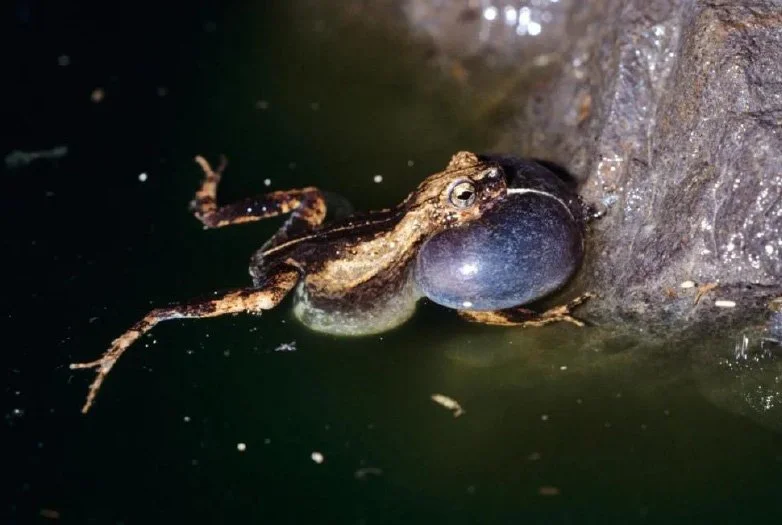
Tungara frogs get their name from their complex mating songs, beginning with a ‘tun’ sound followed by as many as seven ‘garas’! Image credit: Marcos Guerra, STRI.
Frogs also have some pretty fascinating applications for human medicine, and are being studied for drugs to help manage pain, fight infection, and even cure cancer! A particularly random example is the Túngara frog (Engystomops pustulosus): an inch-long amphibian from Central America and the Caribbean, that when mating produces a ‘protein foam’. For the frogs, this foam acts to protect their eggs from predators, heat, UV exposure or harmful microbes, but scientists have also found that it possesses ideal properties for applying medicine to human skin. Most interestingly, it was observed that the foam could deploy a drug slowly over time, and given that frog skin is so much more sensitive, it would be unlikely to cause any kind of allergic reaction. We speak about saving the frogs, but with so much amazing medical potential, could it be the frogs who save us?
If you needed convincing, hopefully you appreciated an insight into just how valuable our amphibious collection is. When we lose a frog species, we lose the earliest environmental indicator; the potential for improving human health; an important link in the food chain. These are just a few reasons why organisations like the Vivarium at Manchester Museum are so important. By being able to study frog species in a controlled environment, we learn how to better protect them in their natural habitat, as well as establishing a back-up population to ensure we never lose out on the amazing contribution they make to our natural world.

Written by Emily Campbell
Hello! I’m Emily, one of the casual curatorial assistants in the Vivarium at Manchester Museum. Outside of my herpetological pursuits, I’m a full-time healthcare communications professional who particularly loves working in the healthcare equity space, and I feel just as passionately about empowering people with the tools to take informed conservation action in their daily lives. As for a favourite herp, I have a real soft spot for the iconic red eyed-tree frog, but Darwin’s frog has been vying for top spot recently as a real symbol of hope for frog conservation (and just look at that face!).