
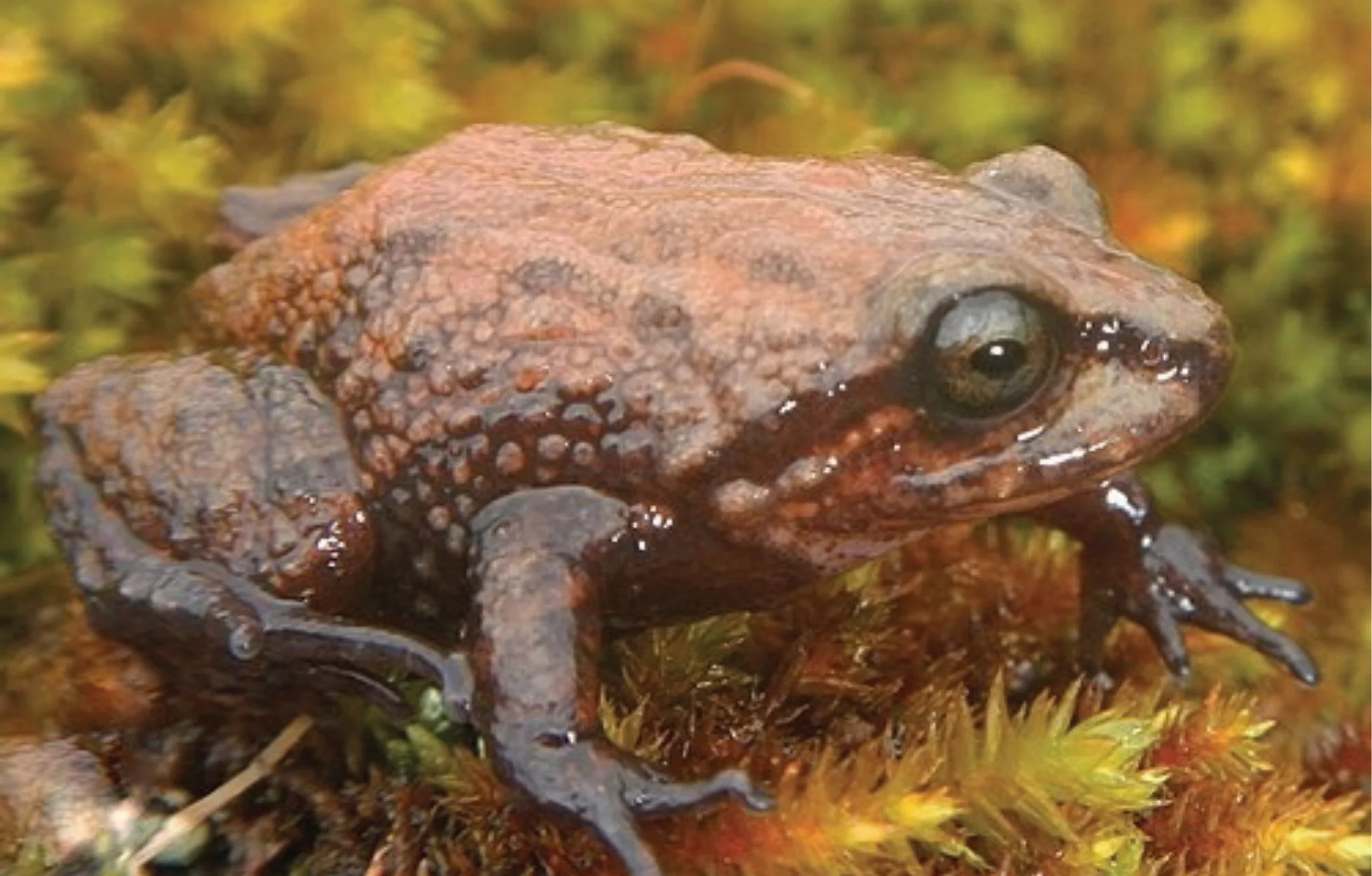
Pristimantis attenboroughi. Photo credit: Dr Edgar Lehr.
Unsurprisingly, one of history’s most famous conservationists has become a popular muse for scientists, with over 50 species named after David Attenborough to date. Despite this, there is currently only one amphibian that shares a moniker with Sir David, and with 2026 marking his 100th Birthday, we couldn’t not honour him with a species spotlight!
This singular amphibian is Attenborough’s rubber frog, or Pristimantis attenboroughi. It was discovered in Peru in 2017 by scientists Dr. Edgar Lehr and Dr. Rudolf von May, on a successful two-year study that resulted in the discovery of several species of frog and one new spectacled lizard. Both researchers initially thought that P. attenboroughi belonged to another genus entirely, which was rectified by further genetic data - a great example of the importance of not just relying on morphological evidence!
The recorded specimens of P. attenboroughi measured up to just 23mm in length, with a range of colours from pale grey to reddish brown, a short, rounded snout and characteristic dark stripes across the face and eyes. Despite their size these tiny frogs have a head for heights, inhabiting mountainous forests up to an elevation of nearly 4,000 meters above sea level. Like many frogs who live at altitude where open water can be more scarce, Attenborough’s rubber frog has evolved to display terrestrial breeding (also known as direct development), in which they hatch as fully-formed miniature froglets and skip the aquatic tadpole stage entirely. This breeding method often results in clutches with fewer, larger eggs to allow the young to gather more nutrients - for example, a female rubber frog was found guarding a clutch of just 20 eggs inside a damp moss pad.
According to the IUCN Red List definitions, P. attenboroughi should be granted a status of either vulnerable or endangered due to the limited number of locations in which it has been found. In a reasonably unique situation however, the researchers suggested that it was instead classified as Near Threatened. The Piu Piu forest in which the species is found is a formally protected and largely unexplored area, so they suspect there are more populations to be discovered.
Upon describing the frog, Lehr and von May said “We dedicate this species to Sir David Frederick Attenborough in honor for his educational documentaries on wildlife, especially on amphibians (e.g., Life in Cold Blood, Fabulous Frogs), and for raising awareness about the importance of wildlife conservation”.
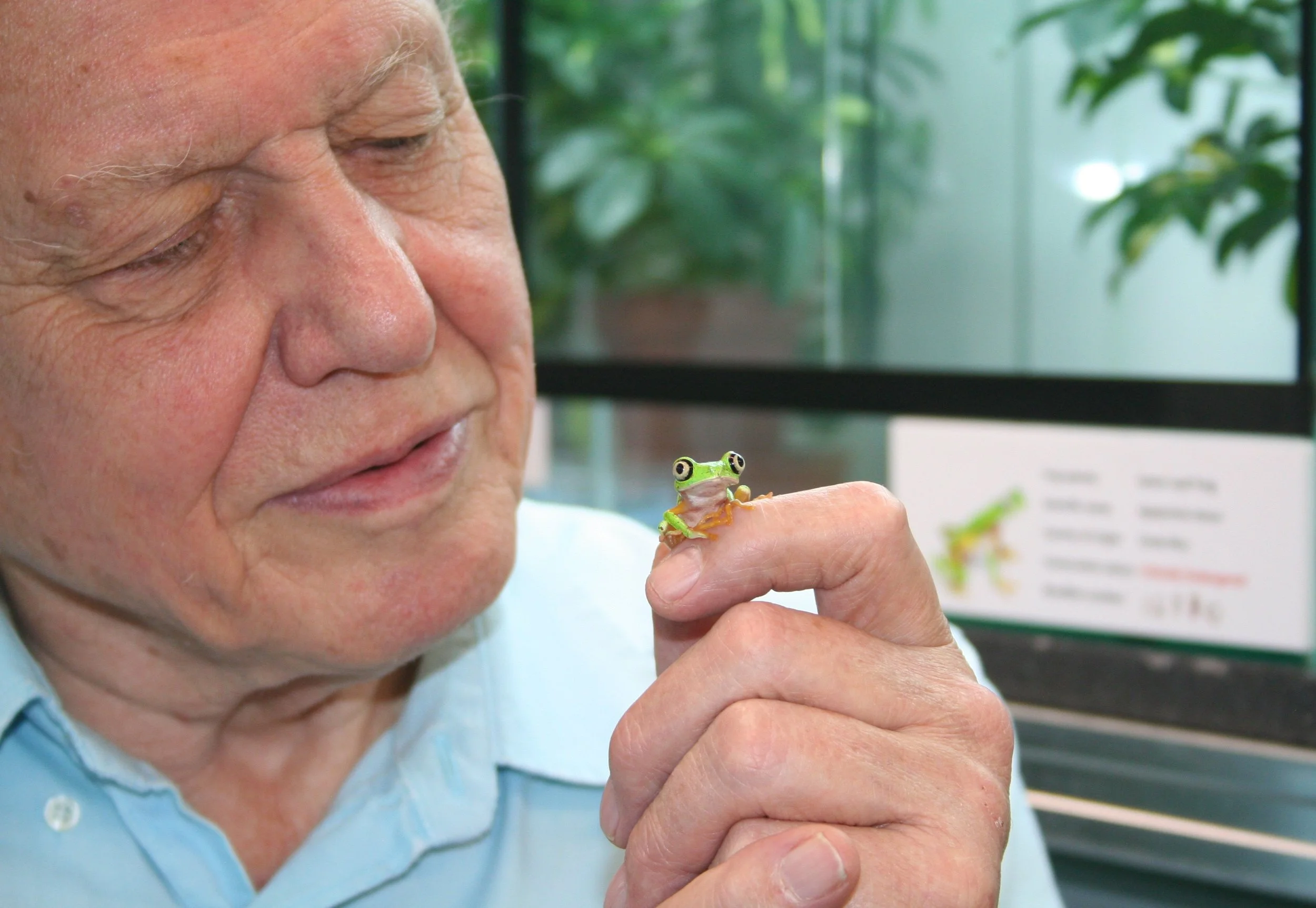
Sir David Attenborough pictures during a visit to The Vivarium.
In 2014, Manchester Museum was fortunate enough to welcome Sir David Attenborough to our Vivarium as part of his filming for the BBC’s Natural World series, shining a light on endangered amphibians and the conservation work that was (and is) happening right here in Manchester. Who knows, maybe we’ll be working with his amphibious namesake one day! A belated happy birthday, Sir David.