
The mystery of the first amphibian
Today there are over 8,700 species of amphibian, from tiny frogs to giant salamanders. Scientists discover new species every year. But where did amphibians come from? Who was the very first amphibian? And how can we be certain?
One animal that helps us understand how amphibians evolved is Tiktaalik roseae. It lived 375 million years ago, before the dinosaurs, and was discovered on Ellesmere Island in Canada in 2006. It looked more like a fish than any amphibians we’re used to seeing today, but it had a flat head like a salamander and strong fins it may have used as legs to help it move around on land. Like Archeopteryx is an example of how dinosaurs evolved into birds, Tiktaalik roseae is an example of the link between fish and four legged land creatures.
But what about something that looks more like a modern amphibian? All living amphibian species belong to a group of animals called Lissamphibia. These are animals that share many similarities including; having two types of skin gland, a special type of breathing that uses movements of the mouth and throat, called buccal respiration, and a lack of bones at the back of their skull.
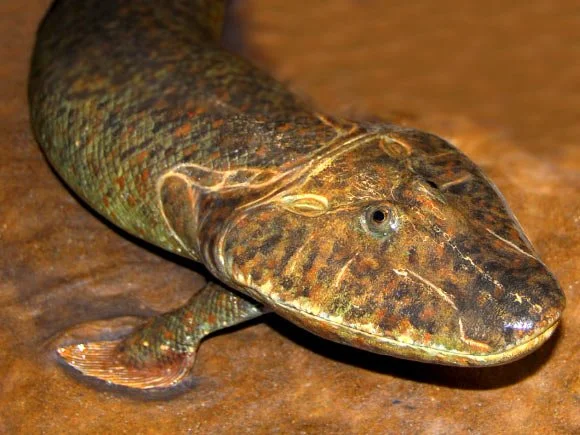
A reconstruction of Tiktaalik roseae. Image credit: Tyler Keillor / Beth Rooney.
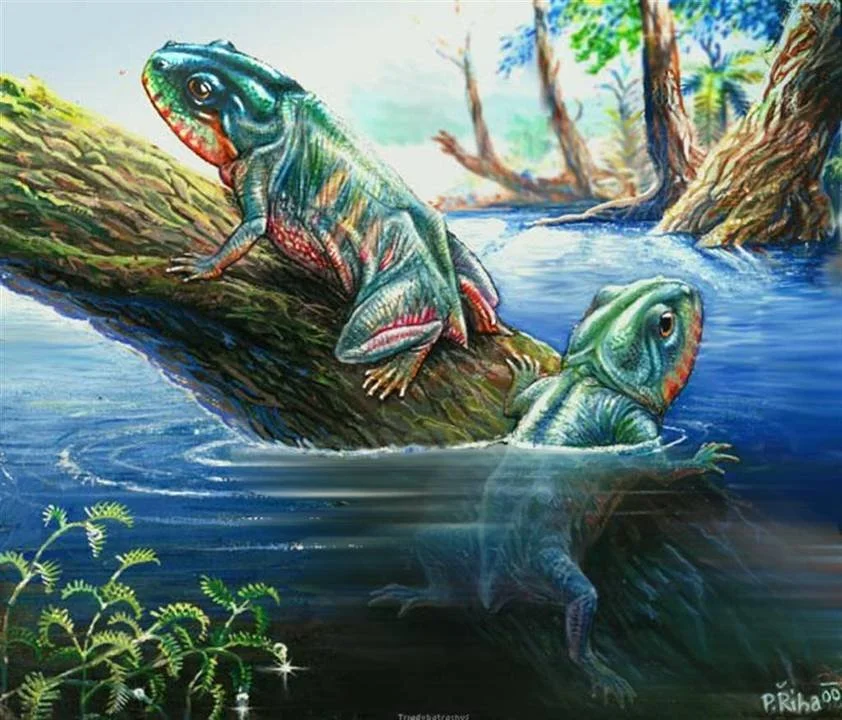
An artist's recreation of Triadobatrachus massinoti.
Triadobatrachus massinoti is one of the earliest examples of Lissamphibia that looks more like a modern frog; a proto-frog. It existed 250 million years ago (125 million years after Tiktaalik roseae). It probably couldn’t jump as well as some of today’s frogs, but it could likely hop and likely propelled itself through the water using its legs. Only one fossil from Madagascar has been found of this species. This is possibly because fossils require very special conditions to develop from a once living creature. This means there could be millions more creatures that once existed, but we might never find evidence of them.
So who was the very first amphibian? This is a difficult question to answer. Scientists devote their entire lives to analysing new and existing fossils and comparing them to living animals. While we have a good idea of evolutionary steps between something that isn’t an amphibian to something that is, there’s still so much more to learn. The good thing about science is we never stop asking questions and we’re always happy to correct ourselves if we think we have a new and better idea.

Written by Christopher
I’m Christopher and I’ve been a part of the Manchester Museum Vivarium since 2019. I have a master’s degree in conservation and outside the Museum I work in data analysis.
My favourite amphibian is Melanobatrachus indicus, the galaxy frog.