
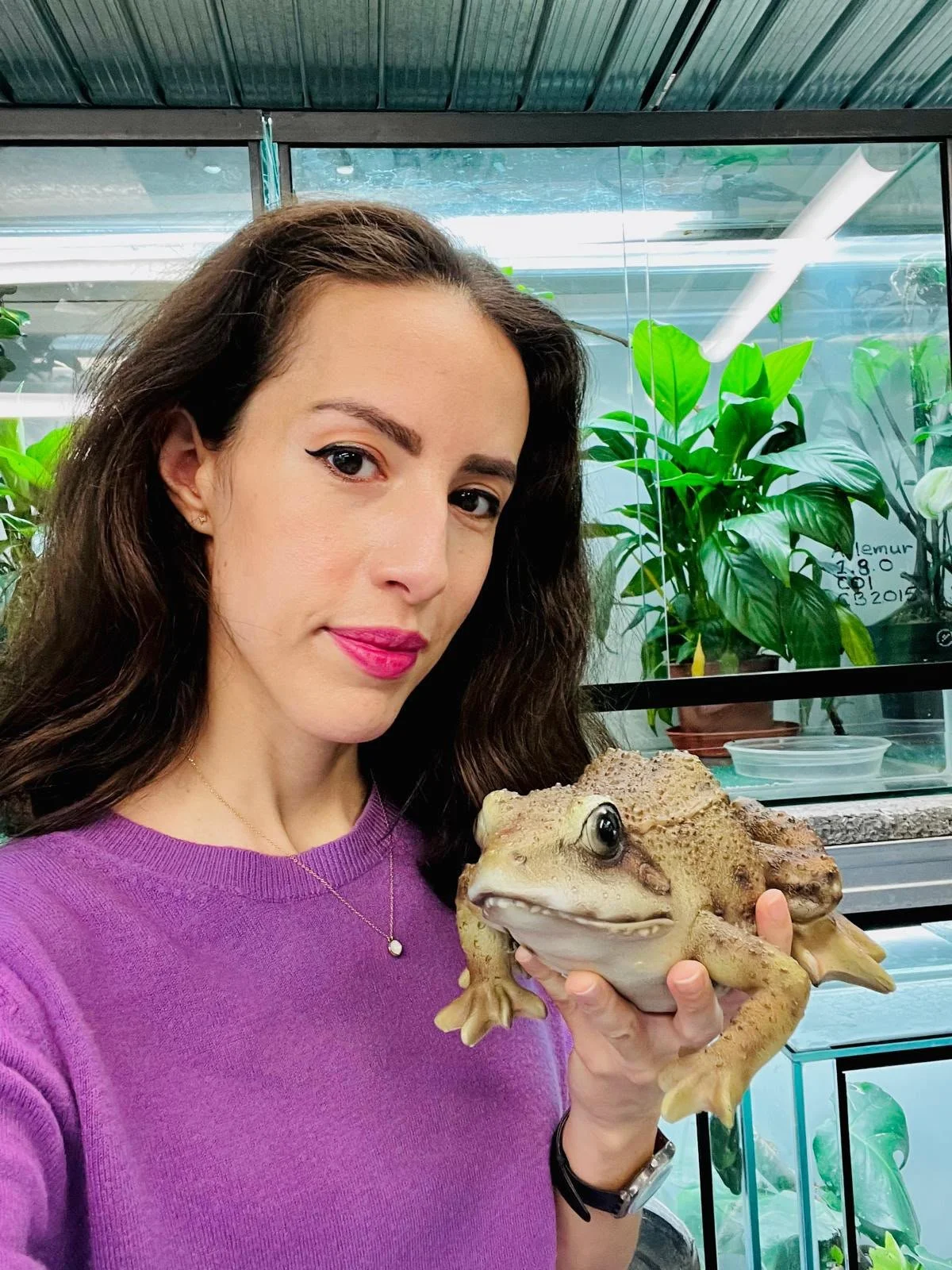
Vivarium Curatorial Assistant Anna-Maria White.
"How do I get into conservation?" is one of the most common questions the Vivarium team receives. With growing interest in wildlife, sustainability and environmental roles, many people are keen to learn more about the routes into the sector and what it takes to build a career protecting some of the world’s most vulnerable species.
To help answer some of the most common questions, we sat down with the Vivarium’s very own Anna-Maria, one of our Curatorial Assistants, to share her route into conservation, what a typical day involves, and the honest rewards and challenges of a similar career path.
Q: What is your role at the Vivarium and what does this look like?
A: As a curatorial assistant I work to maintain the Vivarium’s live herpetological collection of animals and habitats for the purposes of wildlife conservation, education and promoting connection to nature. The curatorial team works closely with several conservation partners, contributing to breeding programmes and species reintroductions.
On a day to day basis I service the needs of the animals, which means a lot of tank cleaning, spraying and pruning habitats, ordering and preparing food, and generally making sure everything is ticking along in the Vivarium. I make observations about the animals’ behaviours and development, as well as measure and record environmental conditions to ensure the collection can thrive. I also supervise our team of volunteers, interns and placement students, and deliver our ‘Sponsor a frog’ behind-the-scenes tours.
Q: What do you love about your job?
A: It might seem an obvious answer, but I love caring for the animals and advocating for them. They are so individually unique in every way, from size to colour to sound, that I find them endlessly fascinating to observe and a joy to work with. I am always learning in my role because my duties are varied and I benefit from working with colleagues who have specialist knowledge and expertise. Providing conservation education to visitors in an accessible way is really important to me and I hope that my passion helps to inspire others to perceive amphibians, reptiles and invertebrates more positively.
Q: What did your education and career path look like to get to your current role in conservation?
A: Originally, I came from a creative background but then pivoted into actively pursuing a long-lived interest in nature by obtaining a BSc in Wildlife Conservation with Zoo Biology from the University of Salford in 2023. During my studies I built practical experience working in a native wildlife rehabilitation unit, freelanced as a bat surveyor, and I went on to work in conservation education and nature communications for both Chester Zoo and Lancashire Wildlife Trust. I began volunteering at the Vivarium in 2023 and have since progressed to be both a casual member of staff and a curatorial assistant. To have the opportunity to work in my dream field of herpetology as a conservationist with several critically endangered species is a truly special job - one that I am ever grateful for.
Q: What do you think would surprise people about the conservation industry?
A: It’s hard work and the amount of cleaning involved can be surprising for people unaware of what practical conservation roles really entail. It’s about 95% cleaning, feeding, sorting. Naturally, there is a lot of poo! So, what I would say is that it is a career of service - one that is highly competitive but also highly rewarding.
Q: What, if anything, would you change about working in conservation?
A: If I had the power to change the industry, I would want to change how it is funded. Conservation roles can be relatively underpaid considering the labour and dedication required. I would love to see the sector be regarded with more importance and prominence, with more permanent roles available as the norm, as funding supports work and projects in the short-term but doesn’t always provide the stability needed to work towards positive change.
Q: What advice would you give to someone who wants to work in a conservation field?
A: If it is your dream to work in conservation - you need to be resilient and not give up. Focus on gaining opportunities wherever you can to build a portfolio of work. Juggling university or college schedules with unpaid internships or experience can be difficult, but proactively gaining practical experience will help you to define which areas of focus you may want to explore and where in the world you want to work. There are many different job roles in the sector, so it’s worth being exposed to many different routes to ensure you know what works for you as an individual. I would also note that having a hidden or visible disability may be a challenge - but can be one you overcome by adjusting roles to fit around your abilities, and having the support of colleagues and a team can help you realise your dream of working in conservation. If I can do it, so can you!
Q: What is your favourite reptile or amphibian, either in the museum or further afield?
A: Within our vivarium collection I would say that my favourite amphibian is the black-eyed Morelet’s tree frog (Agalychnis moreletii). They can be found in Latin America and in El Salvador, where my family is from, so I have a soft spot for them as a species. Further afield, I must admit that the ancient reptile species, Tuatara (Sphenodon punctatus), from New Zealand is quite an amazing creature. I was fortunate to be introduced to one through its keeper earlier this year at Chester Zoo, and once I heard its sleepy croak, I haven’t been able to stop thinking about how this ‘living fossil’ evolved 250 million years ago, before dinosaurs