
Riding with faith: a Mancunian story
By Michelle Scott
There is a motorcycle in the South Asia Gallery at Manchester Museum.
It draws people to step closer, to see, hear and feel a story that will stay with them, long after they have left the Gallery. You can see it happen. A pause, a shift in pace, a second look. The motorcycle is neither rare, nor beautiful, but it holds something human that is difficult to pass by.
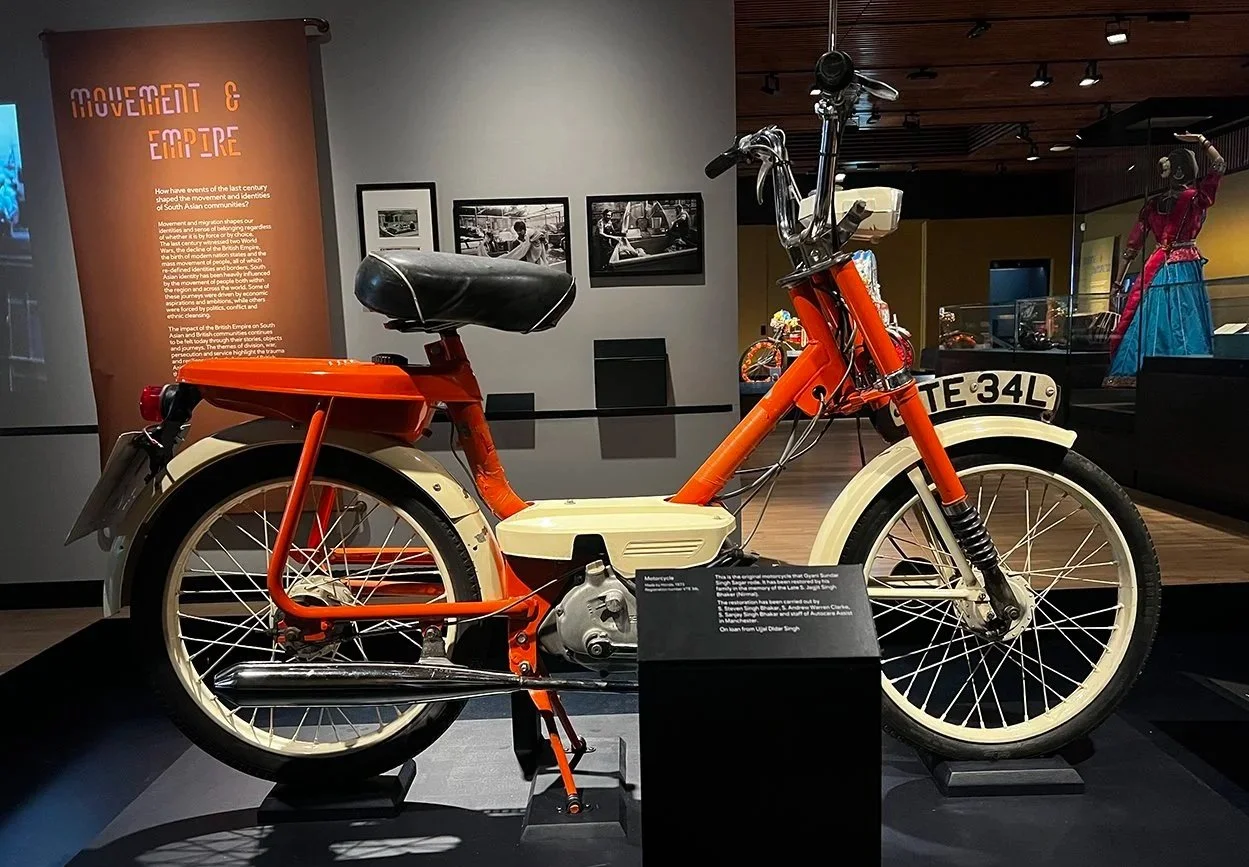
THE MOTORCYCLE OF GYANI SUNDAR SINGH SAGAR, ON DISPLAY IN THE SOUTH ASIA GALLERY AT MANCHESTER MUSEUM.
This is a Manchester story.
The motorcycle carries the life and actions of Gyani Sundar Singh Sagar, better known as Gyani Ji, a Sikh activist who made this city his home and who refused to accept that participation in public life should come at the cost of faith.
In the 1970s, when the law required motorcyclists to wear crash helmets, Sikh riders who wore turbans were placed in an impossible position. Gyani Ji refused to choose between his faith and the law. He continued to ride wearing his turban, despite being repeatedly stopped by police, fined, arrested and brought before the courts. Each journey carried the possibility of another prosecution. When Gyani Ji was released from Strangeways Prison, his son Ujjal Singh was waiting outside with his father’s motorcycle. Community leaders and the press had gathered at the gates and garlands were placed around Gyani Ji in celebration of his refusal to compromise his faith. His actions formed part of a wider campaign by Sikh riders across Britain, who challenged legislation that prevented them from practising their faith while using the roads. Their persistence contributed to changes in the law that recognised the wearing of turbans as a protected religious practice.
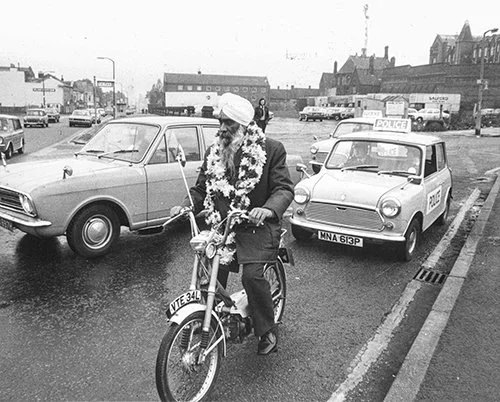
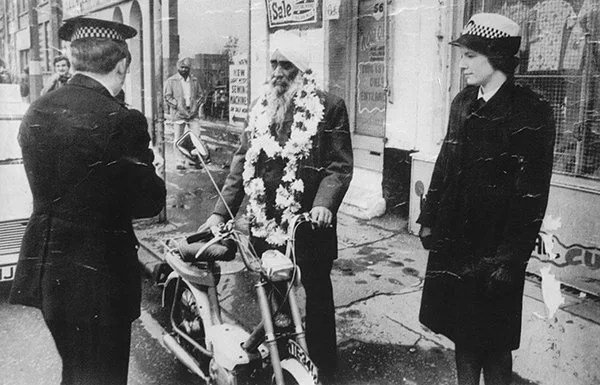
GYANI SUNDAR SINGH SAGAR BEING PULLED OVER BY POLICE WHILE RIDING HIS MOTORCYCLE THROUGH THE STREETS OF MANCHESTER AND SPEAKING TO POLICE BY THE SIDE OF THE ROAD.
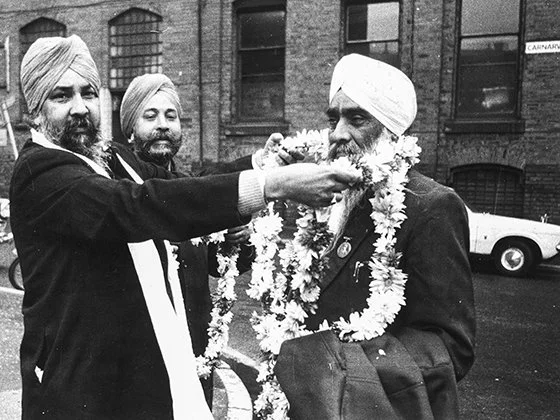
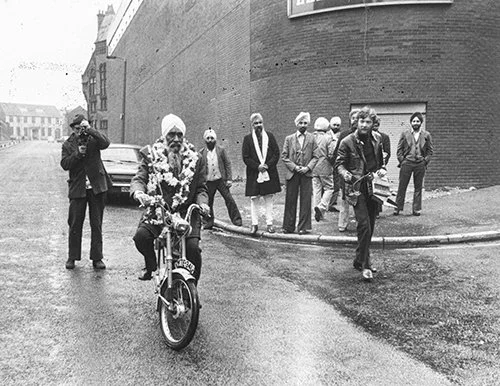
GYANI SUNDAR SINGH SAGAR HAVING A GARLAND PLACED AROUND HIS NECK AND RIDING HIS MOTORCYLE AWAY FROM STRANGEWAYS PRISON IN MANCHESTER.
This story is often told as a narrative of this protest and eventual legal change, and it is that. But in the Gallery, something else comes through more quietly.
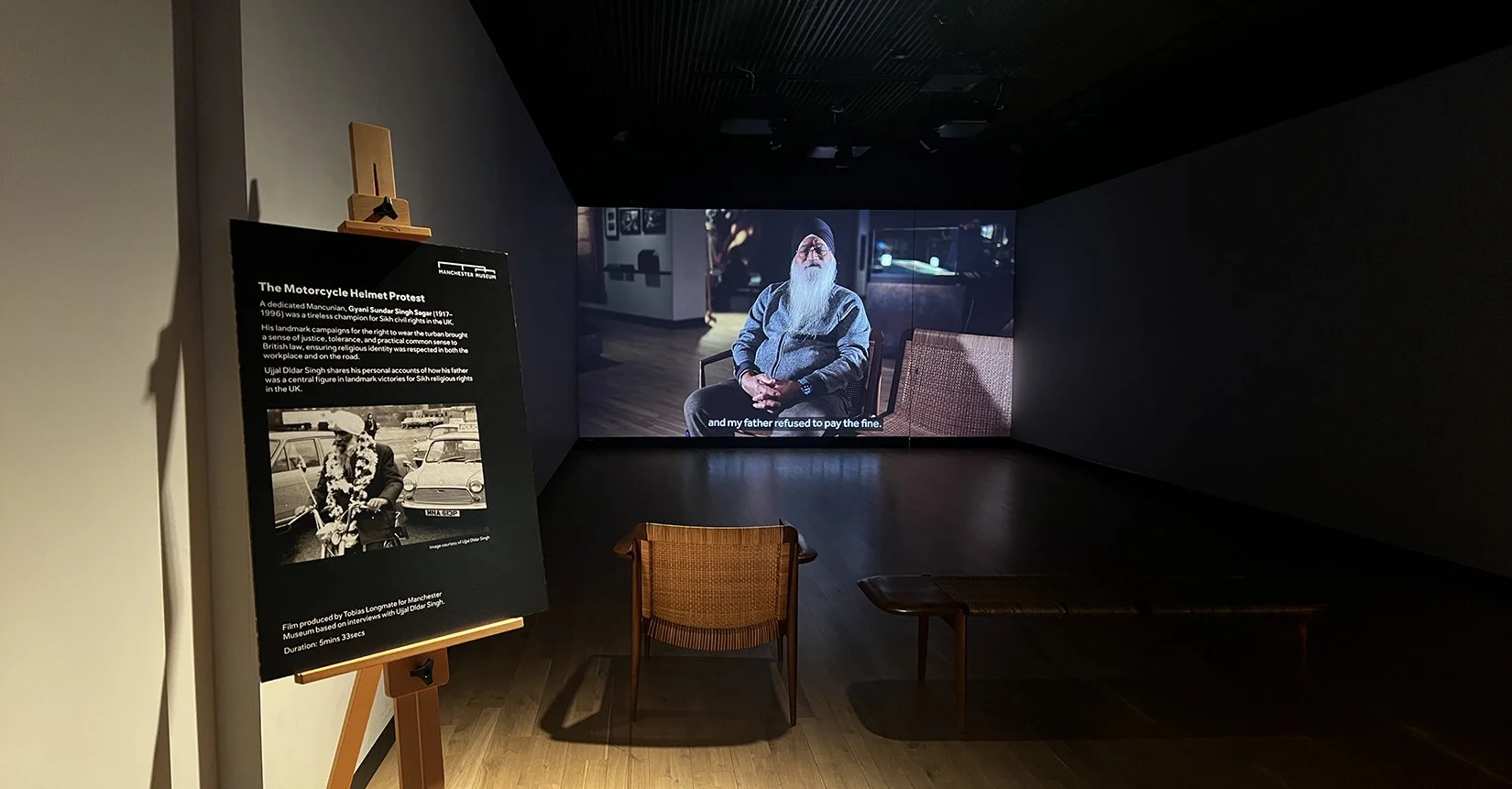
It comes through in the voice of his son, Ujjal Singh.
In a film that accompanies the display of the motorcycle, Ujjal speaks about his father with a clarity and warmth that fills the South Asia Galley performance space. It is not only a history that is being shared, but a relationship. The sense of pride with which he speaks is tangible, it begins with a son talking about his father but it does not end there. You can feel it as people watch. Pride becomes something shared, something held collectively, even among those coming to this story for the first time.
This is part of what makes the display so affecting, it is not an account flattened by time or distance, it carries the texture of lived experience, still close to the surface. This reflects the collaborative process which continues to shape the South Asia Gallery. Stories begin with people.
And then there is the motorcycle itself.
This is not a prop, a replica, or a symbolic object brought in to represent an idea. This is the motorcycle. The one that was ridden. The one that moved through Manchester’s streets as part of an act of refusal and insistence.
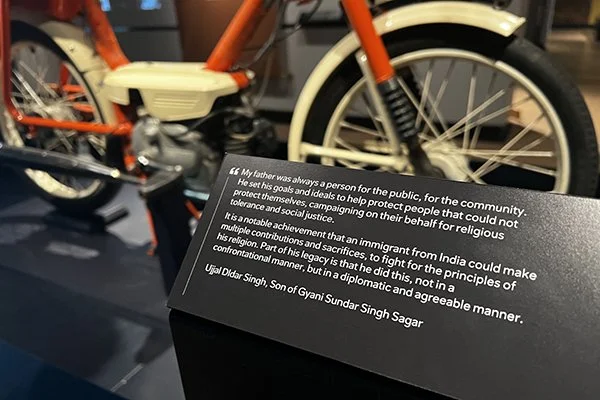
A QUOTE FROM UJJAL DIDAR SINGH, SON OF GYANI SUNDAR SINGH SAGAR, ON DISPLAY IN THE SOUTH ASIA GALLERY AT MANCHESTER MUSEUM.
In museums, objects are often asked to illustrate stories that exist elsewhere, outside themselves. But here, the motorcycle is the physical storage of memory. It has been shaped by this story, marked by it and has helped shape what became possible. The legal changes that followed were not abstract processes. They came through people insisting on practising their faith in public, despite the obstacles they faced.
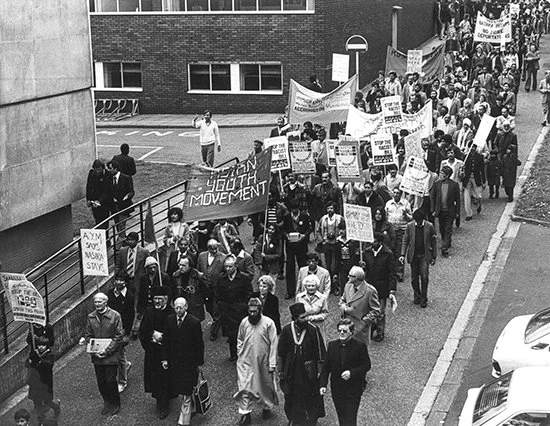
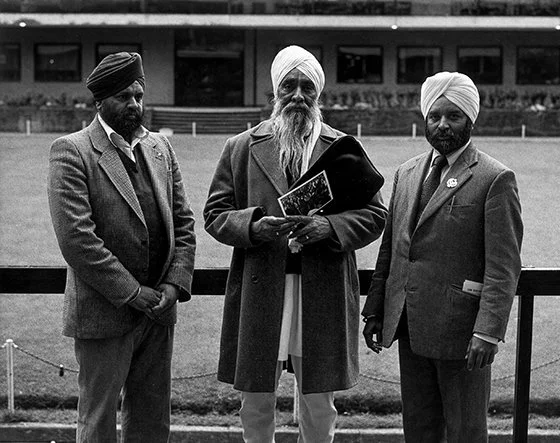
A PROTEST WALKS THE STREETS OF MANCHESTER, IN SUPPORT OF GYANI SUNDAR SINGH SAGAR, ON DISPLAY IN THE SOUTH ASIA GALLERY AT MANCHESTER MUSEUM; GYANI SUNDAR SINGH SAGAR STOOD WITH FELLOW MEMBERS OF THE SIKH COMMUNITY.
This is what it means to think with storied objects.
The motorcycle does not sit quietly. It holds together faith, law, everyday life and the city itself. It asks us to think not only about what happened but about who carries that history, who tells the story and how it continues to be shared. This is central to the South Asia Gallery, which was built through collaboration with people whose lives and histories are connected to the objects and stories on display. That work is not only present in the labels or interpretation. It is felt in the authority given to lived experience.
To call this a Manchester story is not simply to locate it geographically.
Gyani Ji’s actions belong to a particular moment in history but they also speak to wider questions of belonging, rights and recognition, questions that have been lived through in this city in very real ways. The streets that this motorcycle once moved along are not separate from the gallery. They are part of the same story.