
Exploring Earth Sciences at Manchester MuseumDr. Nidia Alvarez Armada, Curator of Earth SciencesBY DANNY ROBERTS | PHOTOGRAPHY BY TOBIAS LONGMATE
How millions of years of history can teach us important lessons for the future.
“I always wanted to be a palaeontologist,” says Dr. Nidia Alvarez Armada, the new Curator of Earth Sciences at Manchester Museum. “My parents say I ran to my dad when I was four and said, ‘Daddy, I want to be a palaeontologist.’ He laughed and said, ‘You don’t even know what that means.’ And I said, yeah, palaeontologist. I never changed.”
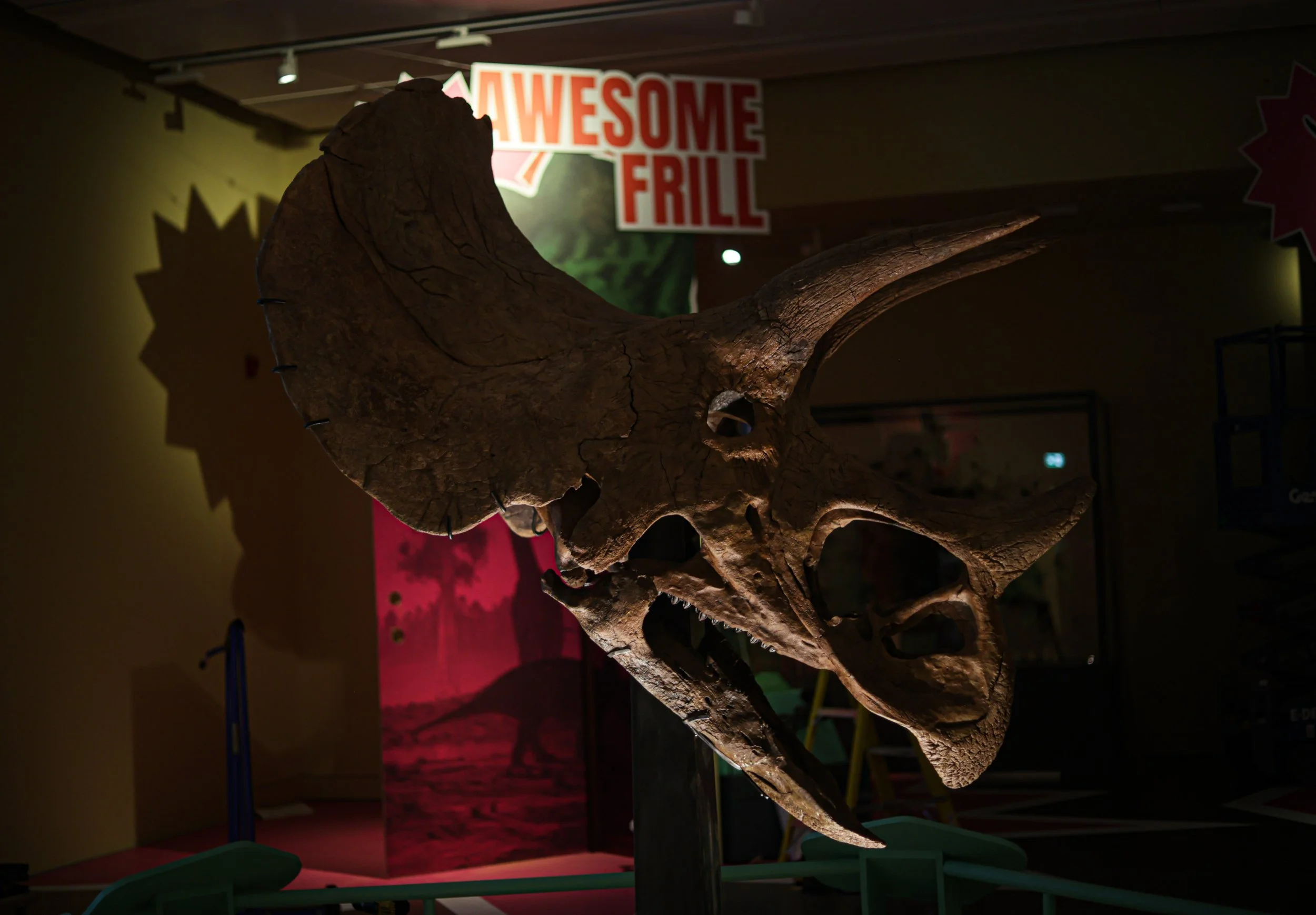
Nidia’s early fascination with fossils and minerals laid the foundation for a career dedicated to understanding Earth’s history and sharing it with visitors, and one of the cornerstones of the new Triceratops Eat, Roam, Repeat exhibition is visitor interaction.
“It’s going to be a much lasting memory if you’re able to touch and experience first-hand, than if you’re just seeing things behind glass,” she explains.
The exhibition features a handling table, where visitors can touch fossils that are 60 to 150 million years old, and Nidia talks about the excitement these encounters inspire, with the awe of someone still discovering them herself for the first time. “They are just wow. It’s something that feels completely new,” she says.
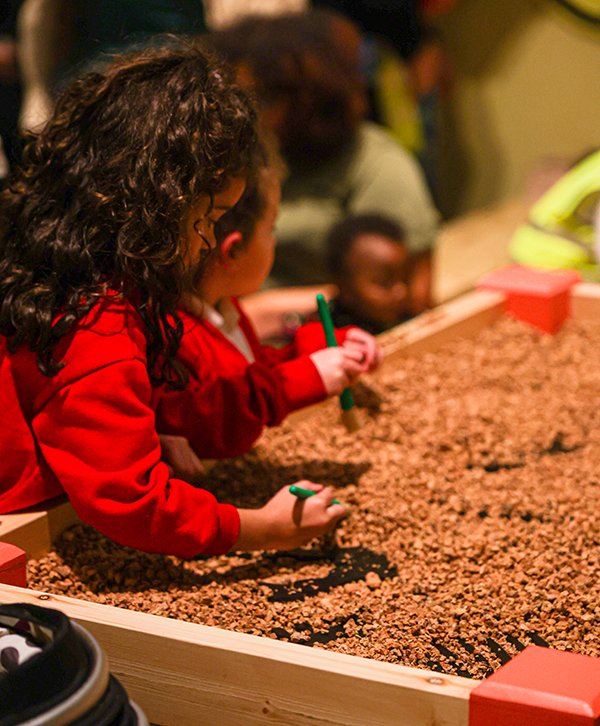
YOUNG VISITORS ENJOY A FOSSIL DIG

NIDIA ALVAREZ ARMADA SHARES COLLECTIONS WITH VISITORS
These fossils give visitors a tangible sense of the vastness of deep time. Nidia remembers a family asking how long keratin takes to degrade, and the look of astonishment on their faces when she answered. “I said, ‘Oh, very little, about 80,000 years.’ They all looked at me like, whoa, what do you mean, really little time?, 80,000 years? Well, I have the mind of a geologist, for me, 80,000 years, like that, is gone. When you start thinking about Leopold (the Triceratops who features in the exhibition), who is 66 million years old, 80,000 is nothing.”
She adds, “If the whole book of Earth was 1,000 pages, we would have been here the last word of the last sentence of the last page.
“If the whole book of Earth was 1,000 pages, we would have been here the last word of the last sentence of the last page.”
Nidia Alvarez Armada, Curator of Earth Sciences at Manchester Museum.
Science in the galleries is always evolving. Even well-known species continue to teach us more. A model of Triceratops that was put together in Victorian times had the tail dragging behind. When more and more fossilised footprints were found, there was no tail dragging. Now it’s displayed with the tail raised a little bit because there’s no evidence to support that it ever dragged behind. Nidia emphasises that curiosity drives science. “What we know is a drop. What we don’t know is an ocean. It’s something that you have to come to terms that whatever you investigate, whatever you research may bring other questions that haven’t been answered yet.”
The Museum is also about encouraging future experts. “Anyone can be an expert. There are children that know more about dinosaurs than I ever will and that’s OK. It’s something that anyone can get to be an expert about, if they’re interested and want to do it. I think that’s something very important for them to understand.”
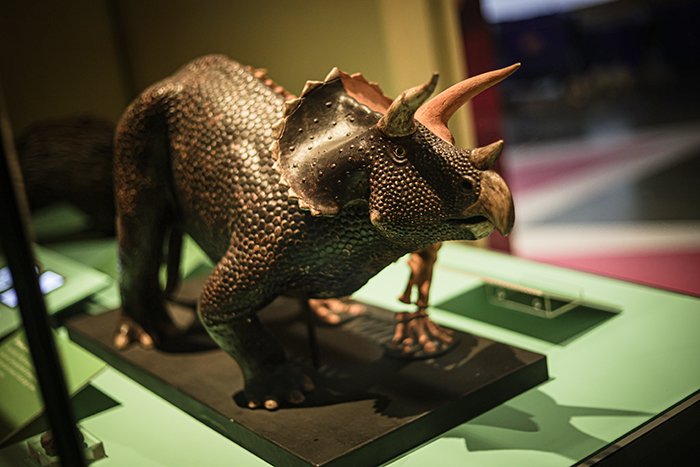
A VICTORIAN TRICERATOPS MODEL FROM THE EXHIBITION TRICERATOPS: EAT, ROAM, REPEAT
By offering access to its vast Earth Sciences collections, around 200,000 specimens, the Museum provides the opportunity for learning and discovery for all.
For Nidia, Earth Sciences is about more than fossils, it’s about connection and curiosity. “We can look back and investigate and use what we know now to understand how things were happening then and using what we know now. It’s very difficult, but it’s exciting. Because there’s always more.” She adds, “Earth Sciences talks about the history of life on Earth and if we don’t understand what happened in the past, then how can we prevent bad things happening in the future?”
Manchester Museum invites visitors to explore, to touch, and to wonder, reminding us that the story of our planet is still being written and there is room for everyone to be part of it.
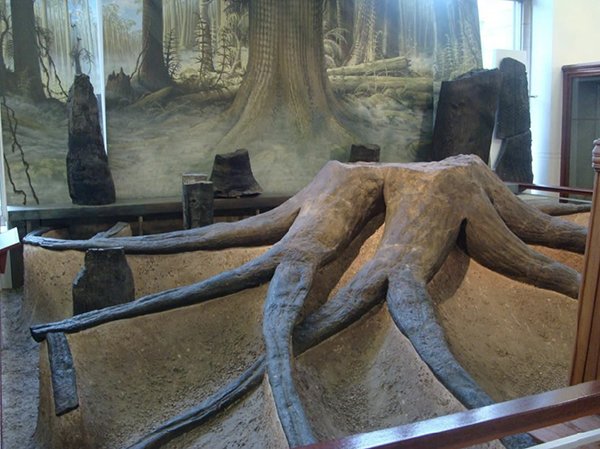
A FOSSILISED TREE WITHIN THE FOSSILS GALLERY AT MANCHESTER MUSEUM.