
GALLERY | FLOOR 1
Egypt and Sudan
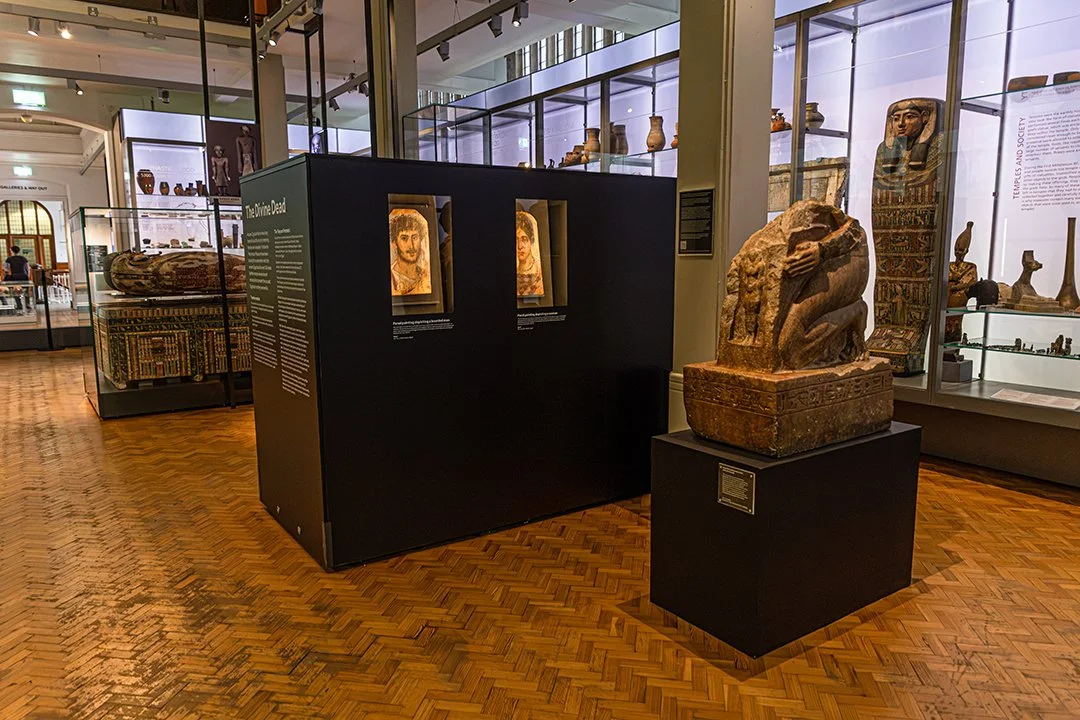
The Egypt and Sudan Gallery tells stories of the people we now call ‘ancient Egyptians’, a diverse population who lived in Northeastern Africa from around 3000 to 30 BCE.
The museum’s outstanding collection of Egyptian and Sudanese objects – one of the largest in the UK – illustrates both everyday life and preparations for the afterlife. As well as the people and places of ancient Egypt, the gallery tells equally important stories about the ways in which objects were found and moved. Following the British invasion of Egypt in 1882, the European-controlled Egyptian government allowed foreign archaeologists to export some of the items they excavated on Egyptian and Sudanese land. This led competitive and wealthy European businessmen to sponsor archaeologists to search for objects which would be displayed in the West.
Take a quick look at the Egypt and Sudan gallery
CARE FOR ASRU
Until September 2026, the mummified body of a woman called Asru was on display in the Egypt and Sudan Gallery.
Asru was unwrapped at the Manchester Natural History Society in April 1825 and displayed almost continuously within the city throughout the two centuries that followed.
This decision to remove her from display, grounded in Manchester Museum’s core values of care and inclusion, reflects changes in how we think about our responsibility towards ancestors, museum collections and the communities they represent.
Before making this change, we consulted with Egyptian colleagues, members of the Egyptian diaspora and visitors to the Museum, helping us to understand people’s feelings about care for mummified people.
The decision to remove Asru from display also aligns most closely with what we understand about her own wishes. Elite Egyptians of her time expected that their mummified bodies would remain wrapped in their coffins, invisible to the living.
Asru now lies in the Museum’s stores within her outer coffin, which will remain closed, but this is not intended to be her permanent resting place. We are thinking about how we better care for ancestors, in line with the wishes of the dead and of living communities. In some cases, this will mean creating more suitable resting places within the Museum, in others it will mean arranging for the return of ancestors to communities of origin.
Hear some reflections on Asru in Egyptian Arabic and English from Egyptian researcher Marwa Elhosary.
-
I am an Egyptian heritage and museum researcher at University of York, but today I am speaking not as a researcher but as an Egyptian woman.
Whenever I walk into a museum and see a mummy on display, a question always comes to mind. If she were alive among us today, would she ever accept to be displayed like this? How did we turn her body into an object for public viewing and completely forget she was a human being?
To me, Asru is not just a mummy in a glass case or a number on a label. She is a soul, a real human being who lived in Thebes thousands of years ago. She is a woman just like you and me. She had family stories and a life. No matter how history debates the details of her life, whether they say she was a chantress, a priestess or anything else, the one thing we can never disagree on is that she was an Egyptian woman with dignity who deserves to be respected, not just exhibit for an entertainment.
If we look back at history, ancient Egyptians cared above all about being buried and protecting the sanctity of the body. But unfortunately, over time, that body turned into a study sample and showcase for displaying bodies.
Today, the museum's decision to move her body to a space that preserves her privacy is a monumental shift. Because by doing this, it doesn't just respect the dead, it respects the living too.
This move doesn't mean erasing or hiding history. In fact, it is a rethinking of how we present history with dignity.
We don't need to display the body to tell its story. If the museum replaces the body’s display with a short video or an audio recording telling her story and let the Egyptians tell it themselves, it's like we are telling her: we remember you. We haven't forgotten your story and you are among your people and family. Giving her back part of the humanity that was taken from her by unwrapping her body.
And this is the goal of my work. If we are not able to return the physical body back home, the least thing we can do is bring back the Egyptian voice to the Egyptian artefacts living abroad. In our own language and in our voices, while respecting the sanctity of our dead.
Let's give Asru her dignity back and prove to the whole world true history was never about displaying bodies. True history speaks when we respect the humanity of the person behind it and let the owner of the story tell it.
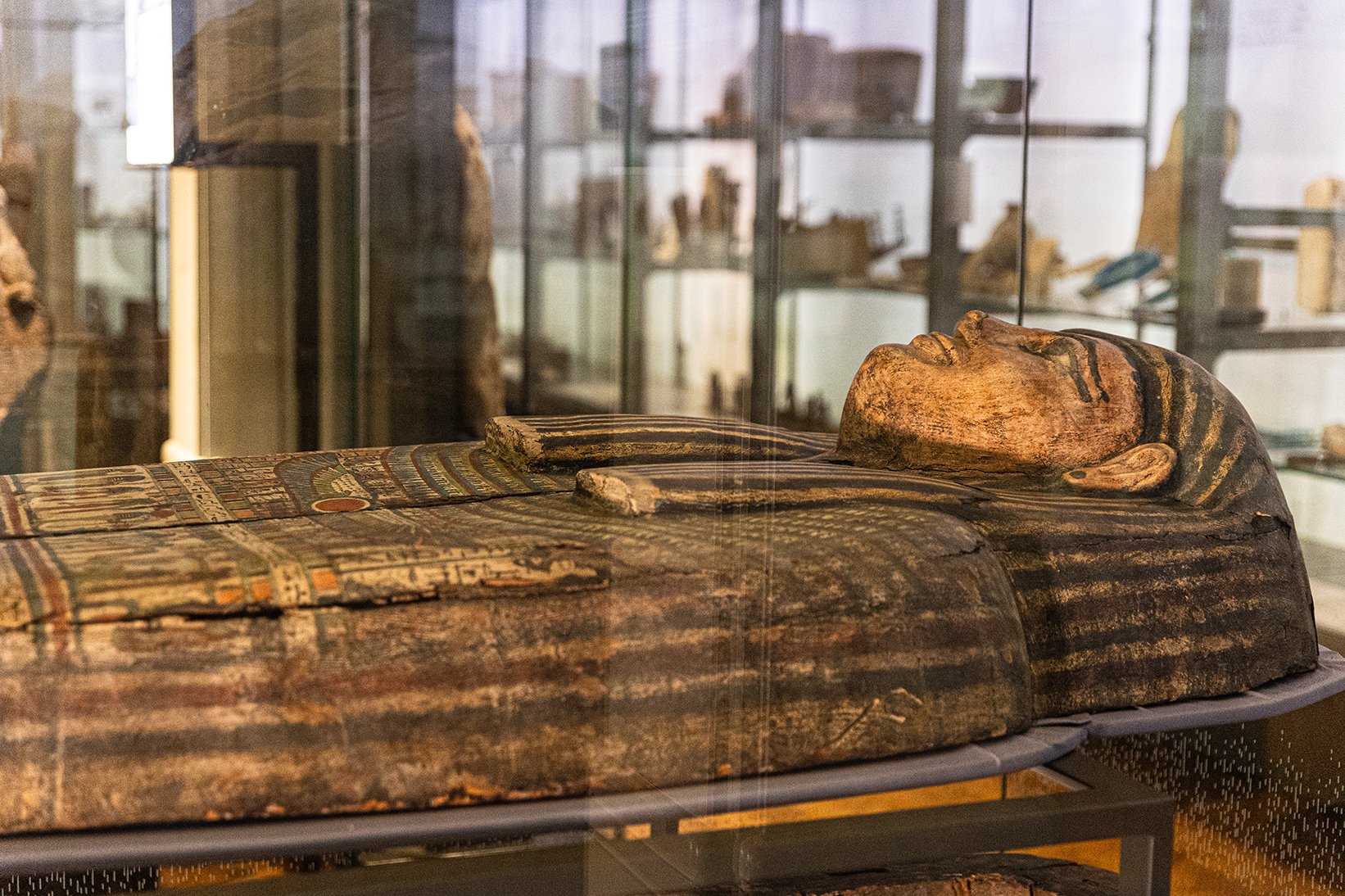
ASRU’S OUTER COFFIN, PREVIOUSLY ON DISPLAY IN THE EGYPT AND SUDAN GALLERY.
Asru’s story
Asru lived and died in southern Egypt around 700 BCE. She was likely buried in Western Thebes (modern Luxor). Her body and coffins were dug up, traded and eventually purchased by Manchester traders William and Robert Garnett in the early 1800s.
When she died the transformative rituals of mummification were performed on her body, which was carefully wrapped in layers of linen cloth and buried into finely decorated wooden coffins. Once ritually wrapped, Asru’s body was not intended to be seen by the eyes of the living. There is textual evidence that the bodies of the dead – made divine by the process of mummification – should not be exposed.
Hieroglyphs on her coffins give the names of her mother Tadiamun and her father, an important official named Pa-Kush meaning the Kushite Man, indicating that he came from the area of southern modern Egypt or northern modern Sudan. For a long time it was assumed that Asru was a temple singer – but a recent re-examination of her coffins showed that she is not given this title in their inscriptions.
She was donated to the Manchester Natural History Society in 1825 by two Manchester merchants, the brothers William and Robert Garnett. Recent research has indicated their father, John Garnett, traded in enslaved people. It is not known if Asru and her coffins were acquired by the Garnetts directly in Egypt or bought in a trading hub like Smyrna (Izmir) in what is now Türkiye.
Asru was on display almost continuously for more than 200 years. She was initially displayed at the Museum of the Manchester Natural History Society and, when that museum closed in the 1860s, was transferred to Owens College, which later became the University of Manchester. Her most recent display dated to the opening of Manchester Museum’s ‘Ancient Worlds’ galleries in 2012, where she was partially obscured from view.
Stories from the gallery
Spinning statue
Visitor Team member Ian recounts the story of the ‘spinning’ statue, which resulted in your Museum’s Egypt and Sudan Gallery receiving worldwide attention.
Asru
The mummified body of a woman named Asru is currently on display within the Egypt and Sudan Gallery and, in the summer of 2025, we started a process of consulting visitors, communities, colleagues in Egypt and staff about her continued display.
Gallery highlights
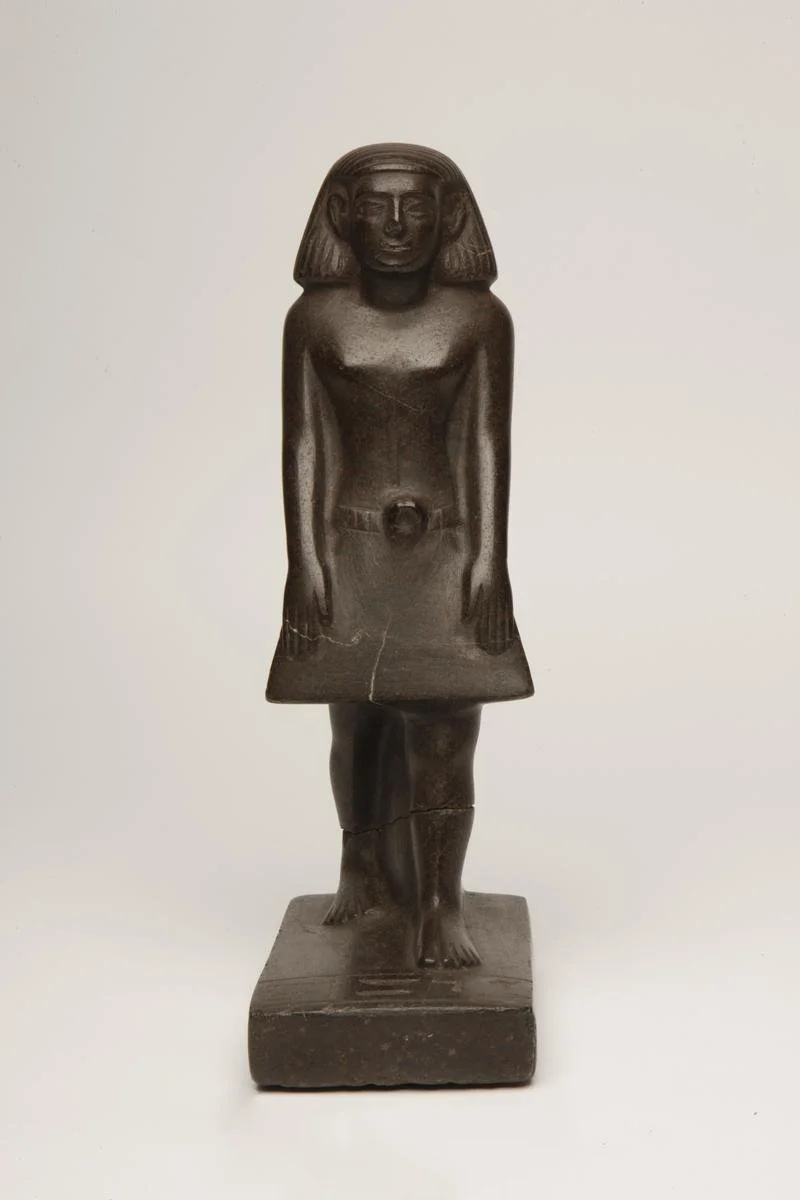
Spinning statue
Famous as the ‘spinning statue,’ this serpentine figure of a man stands with left foot forward, wearing a wig and kilt, hands resting palm-down in a gesture of prayer to the gods.
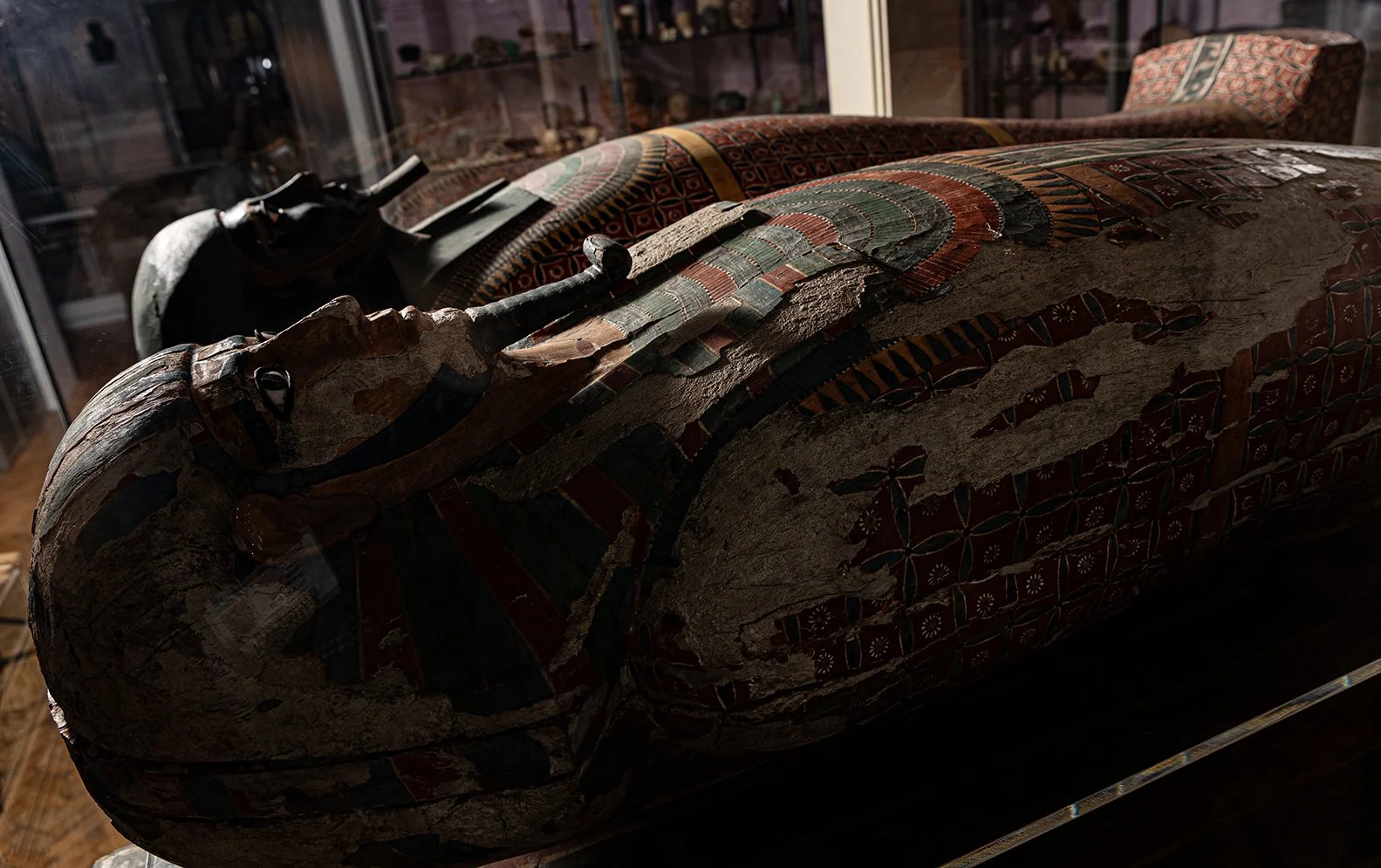
The ‘Two Brothers’ tomb group
The Tomb of Two Brothers from Deir Rifeh, Egypt, dates to the 12th Dynasty and holds the chamber tomb of high-status priests Nakht-Ankh and Khnum-Nakht. The complete tomb group is part of our displays and research collection.
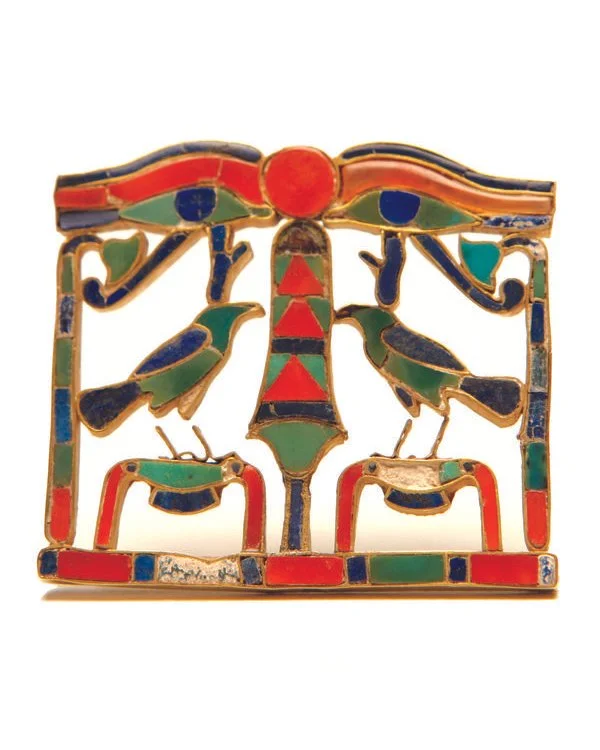
The Riqqeh Pectoral
The Riqqeh Pectoral, a Twelfth Dynasty gold chest ornament inlaid with lapis lazuli, carnelian, and turquoise, exemplifies Middle Kingdom royal jewellery and is among the most intricate and colourful pieces in the collection.